Titan Clean Fuels and TURN2X Agree e-Methane Supply Deal

Titan Clean Fuels has signed an off-take agreement with green energy supplier TURN2X to deliver e-Methane to the maritime industry from 2028 onwards.Titan operates seven bunker vessels and is able to deliver in around 52 ports today.TURN2X’s modular and load-flexible production plant in Miajadas, Spain, converts renewable energy and biogenic CO₂ into ISCC-certified e-methane. This green fuel is then fed into the grid and transported to major European ports, where Titan bunkers it to ship operators.E-methane can achieve net-zero greenhouse gas (GHG) emissions on a well-to-wake basis…
Deltamarin Signs Design Contract for Meriaura Open Deck Carrier

Deltamarin has signed a basic design contract with Jiangsu Zhenjiang shipyard (Group) CO., LTD for Meriaura’s new open deck carrier.Design work will start immediately at Deltamarin Finland, with delivery scheduled for early 2028. The ordered 6,800 DWT open deck carrier is 120 meters long and features 1A ice class and DP2 notation.Deltamarin developed the vessel concept together with Meriaura during 2025, based on Meriaura’s two preceding open deck carriers. The contract signed with the builder…
Skarv Shipping Opts for Wärtsilä’s Ammonia Solution for New Cargo Vessel

Technology group Wärtsilä will supply its Wärtsilä 25 ammonia solution to power a new cargo vessel for Norway-based Skarv Shipping Solutions, marking the first newbuild to use the company’s four-stroke ammonia engine technology.The vessel will be constructed at Huanghai shipyard in China and is intended to support Skarv Shipping Solutions’ strategy to deliver sustainable short-sea shipping services in Northern Europe.Wärtsilä will provide the Wärtsilä 25 Ammonia engine together with the complete fuel gas supply system and exhaust after-treatment…
Is There a Viable LNG to Ammonia Fuel Pathway?

Is LNG to ammonia a viable pathway for helping shipowners get to net zero?From an engine point of view there is a pathway, but there are two points to consider, says Lars Tingbjerg Danielsen, Two-Stroke Promotion Manager – Newbuildings at Everllence. First, the case where an engine is capable of burning both methane and ammonia; second the case where an engine starts its service burning methane and then later switches to burning ammonia.“If we look at the idea of an engine capable of burning both methane and ammonia, it is our belief that this is not a request from the market.
Oldendorff to Reduce Iron Ore Trade Emissions

Salzgitter Flachstahl and Oldendorff Carriers have entered into a long-term agreement to reduce carbon emissions in the maritime transport of iron ore, marking a further step toward decarbonizing Salzgitter’s steel supply chain.Starting in January 2026, Oldendorff will transport iron ore for Salzgitter from various loading ports to Hamburg using bulk carriers operated with a focus on fuel-efficient practices. By optimizing cargo flows and routing, the collaboration is expected to reduce CO₂e emissions by at least 20%.
Global Ethanol Association Launches

The Global Ethanol Association (GEA) has officially launched as an independent, non-profit international organization headquartered in Switzerland.GEA’s mission is to unite resources and expertise, foster cross-sector collaboration, and amplify a powerful industry voice to unlock new opportunities across emerging sectors and accelerate sustainability, innovation, and growth in established ethanol markets.“The Global Ethanol Association represents a transformative step for ethanol as a strategic enabler of sustainable solutions across industries” said Sylvain Zurcher…
The Importance of Methane Number for Marine Engines

The current standards for LNG for marine use (ISO 23306:2020) don’t define limits for Methane Number even though it is an important fuel characteristic that can vary with fuel source and the addition of bioLNG into fuel blends.Power generation organization CIMAC’s Working Group 17 says Methane Number is like the Octane Number of gasoline in that it is a measure of the fuel’s resistance to auto-ignition or engine knock.In diesel engine combustion, gaseous fuel in the cylinder is put under high temperature and pressure as the flame front advances.
WinGD, Hanwha Develop Variable Compression Ratio Engine for LNG Carrier
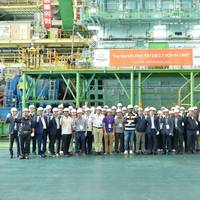
Swiss marine power company WinGD and marine engine manufacturer Hanwha Engine have produced the world's first X72DF-2.2 VCR engine equipped with Variable Compression Ratio technology. This low-emission engine technology, developed by WinGD for ships using both LNG and diesel fuel, maximizes fuel efficiency and reduces methane slip which means vessels can operate more cleanly and cost-effectively, ensuring compliance with stricter emissions regulations.The two companies held a…
WinGD Joins Methane Abatement Initiative for LNG-Fueled Ships
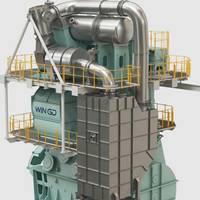
Engine developer WinGD has joined the Methane Abatement in Maritime Innovation Initiative (MAMII), becoming the first engine developer to become a partner in the growing cross-sector push to better understand and address methane from LNG-fueled ships.LNG, primarily methane, can play a role in reducing shipping emissions. But its climate benefits depend on methane being effectively managed. Proven technologies for onboard methane abatement are emerging, and organizations like WinGD…
Wärtsilä Expands Introduces NextDF Technology for Third Engine
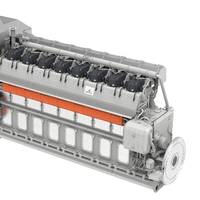
Technology group Wärtsilä has introduced its NextDF technology for a third engine, the Wärtsilä 46TS-DF dual-fuel engine. While operating on liquefied natural gas (LNG), the Wärtsilä 46TS-DF engine with NextDF feature reduces methane emissions to less than 1.4 percent of fuel use across all load points, achieving as low as 1.1 percent in a wide load range. This is nearly three times lower than the default methane slip factor of 3.1 percent, specified in the FuelEU Maritime and IMO Lifecycle Guidelines for Otto-cycle four-stroke dual-fuel engines.
Wärtsilä’s Engines to Power South American Vessels
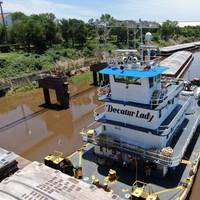
Technology group Wärtsilä has been selected to supply replacement engines for two inland waterway tug pusher vessels operating in Paraguayan rivers.The vessels are owned by ADM Naviera Chaco (ADM). The vessel modifications and new engine installations will be carried out in Asuncion-Paraguay.The new engines will enable a reduction of the environmental impact and increase the efficiency of the tug pushers.ADM’s stated target is to reduce emissions by 25% by 2035, and the advanced…
With CAT’s Methanol Engines, Sustainable Shipping is Possible
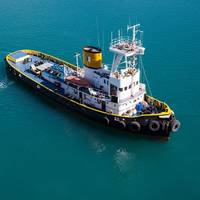
Recently, MarineNews sat down with Will Watson, Caterpillar Marine’s Product Manager, to discuss its rapidly emerging methanol engine development. Caterpillar Marine has already taken a considerable step forward in sustainability by planning to offer an upgrade kit for its methanol-fueled, dual-fuel Cat 3500E series engines. The immediate and long-term goal is to quicken the maritime industry transition to renewable energy.The initiative, announced at an international tug & salvage trade event…
Scandlines to Convert Rostock-Gedser Ferries to Methanol
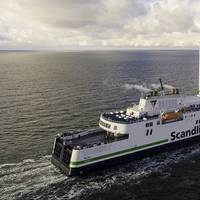
In its sustainability report, Scandlines committed to ferry operations with zero direct emissions by 2040.In support of this, the ferry company has signed an MoU with Caterpillar Motoren to explore the possibilities of converting the current MaK diesel of the Rostock-Gedser hybrid ferries to run on e-methanol. The use of e-methanol produced from renewable energy sources can reduce CO2 emissions by 95% under ideal circumstances.Scandlines already combines three technologies on the Rostock-Gedser route: traditional diesel operation, battery operation and wind power.
When it Comes to Workboat Engines, the Future is Flexible
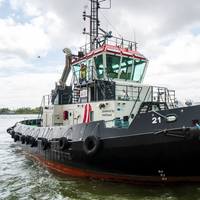
Vessel owners are making new fuel choices, but increasingly, they have options to help reduce the risk of doing so.The latest engine developments aim to make it easier for owners to avoid the chicken-and-egg fuel price and availability risks of new fuels.As Roger Holm, President of Wärtsilä Marine and Executive Vice President at Wärtsilä Corporation recently pointed out, the challenge is that owners won’t commit to a fuel today that is expensive, only produced in small quantities and may be usurped by another fuel that scales faster and more affordably.
New Product: Cylinder Scuffing Detection Tool
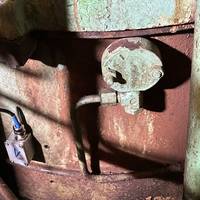
Ships trials reportedly confirmed that CM Technologies’ new scuffing sensor can detect early onset cylinder wear in marine diesel engines. Trials onboard a number of large containerships and a two-stroke engine Baltic ferry showed it was possible to measure the friction in the cylinder when the engine is running.CMT noted a trend in cylinder liner scuffing following the widespread use of 0-0.50% low sulphur fuel (LSF). These fuels together with insufficient or over lubrication…
New Technology Offers Early, Rapid Detection of Cylinder Liner Wear

Condition monitoring solutions company CM Technologies (CMT) has developed new tools to assess the condition of lubricating oils and cylinder liners.The company’s new WBS IR Analyser is an advanced all-in-one infrared-based solution designed to assess the Base Number, soot and water content of cylinder and system oils, while the new CMT Scuffing Sensor can detect sudden and severe wear of the engine’s cylinder liners and piston rings well before other systems can see it.“Modern…
WinGD and CMA CGM to Trial Dual-Fuel Engine Tech at Sea
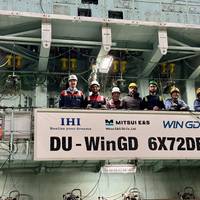
Swiss marine power company WinGD has teamed up with global shipping line CMA CGM to test its Variable Compression Ratio (VCR) technology for dual-fuel engines onboard one of CMA CGM’s vessels.The collaboration marks the first field test for the new dual-fuel engine technology and follows successful factory tests showing significant efficiency improvements with both diesel and LNG fuel.The CMA CGM project comprises a long-term, full-scale test to confirm operability and reliability.Onboard testing is expected to begin following the dry-docking of the vessel in September…
MOL to Invest in Engine Fuel Efficiency Tech Developer

Mitsui O.S.K. Lines (MOL) has set out plans to invest in Carnot, a start-up company that develops technology for highly efficient engines using heat-resistant materials.Carnot is technology start-up developing ways to dramatically increase engine fuel efficiency, while slashing greenhouse gas (GHG) emissions.Steel and aluminum engines require constant cooling to prevent them from overheating, which reduces performance and increases the risk of engine failure. Therefore, about…
MMMCZCS Calls for Early Regulation of Methane Slip
The Maersk Mc-Kinney Møller Center for Zero Carbon Shipping (MMMCZCS) has released a new report: Tackling methane slip in shipping.Past research at the MMMCZCS has demonstrated that current regulations that include methane, such as CO2-equivalent fuel standards (e.g., FuelEU Maritime), will have a limited effect on reducing onboard methane emissions in the short- to mid-term. Furthermore, the default methane slip value concept does not provide a direct incentive to engine makers…
Shaping a Safer and Sustainable Future for Shipping
Sunil Krishnakumar, Senior Technical Manager at the International Chamber of Shipping, provides his key insights on the newly released Engine Room Procedures Guide, Second Edition, by ICS.The shipping industry has embarked on a transformative journey, actively working towards a sustainable future and a safer environment. With a strong commitment to reducing greenhouse gas emissions, the industry is actively seeking the uptake and safe use of new low-GHG technologies and alternatives…
Wärtsilä to Deliver Its First Ammonia Ship Engine in Early 2025
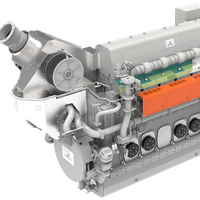
Ship engine manufacturer Wärtsilä expects to deliver its first ammonia-fueled engine on a new vessel in early 2025, with more widespread sales expected in the 2030s, a company executive told Reuters.Ammonia is among several alternative fuels that shippers are exploring to reduce carbon emissions.The company launched its first ammonia four-stroke engine for orders in the fourth quarter last year, with the first such engine to be delivered early next year on a vessel, Roger Holm…
Adapted ME-GI Gas Engine Runs on Hydrogen
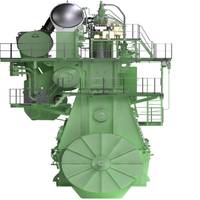
MAN Energy Solutions’ licensee, MITSUI E&S Co. Ltd., has announced that it has successfully tested a 50-bore MAN B&W two-stroke engine up to 100% load at its Tamano facility while running on hydrogen, a world-first for the maritime industry.In collaboration with MAN Energy Solutions, MITSUI converted one of the four cylinders of an MAN B&W ME-GI (-Gas Injection) engine to hydrogen operation. The hydrogen was supplied from a hydrogen gas-supply system that MITSUI developed in 2023.Stable operation was achieved at various loads and operating conditions…
Wärtsilä Partners Up with EBDG to Reduce Port Emissions Across North America
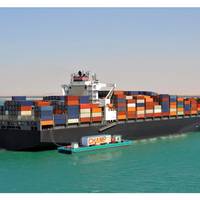
Finnish technology group Wärtsilä has entered into a collaboration agreement with U.S.-based naval architecture and marine engineering firm Elliott Bay Design Group (EBDG) to further develop its Clean Harbor Alternative Mobile Power (CHAMP) Barge design.Featuring Wärtsilä’s methanol engine technology, the collaboration introduces a solution to reduce emissions from large vessels in situations where conventional shore power is limited or not available.The floating mobile power…