

Managing Risks in Battery-Related Marine Fires: A Practical Perspective on Investigation, Subrogation

As lithium-ion batteries continue to make their way into the marine space whether through vessel systems, transported electric vehicles, or everyday devices onboard we are starting to see a different type of fire loss than most of us have traditionally dealt with.These events are not necessarily more frequent, but when they occur, they tend to be severe. In many cases, they result in prolonged fires or even total loss of a vessel or cargo. That aligns with broader industry findings that fires remain one of the costliest drivers of marine insurance losses…
ABS and Partners to Develop Conditional Unmanned Bridge

ABS, Polaris Shipping, HD Hyundai Heavy Industries (HHI) and autonomous navigation solutions provider AVIKUS have signed a four-party Concept Study Agreement for the implementation of a Conditional Unmanned Bridge.Under the agreement, the parties will jointly develop an autonomous navigation concept enabling unmanned bridge operation during deep-sea voyages, when defined conditions are met, on one of Polaris Shipping's 325K Very Large Ore Carriers (VLOCs).The concept is not a fully unmanned operation across the entire voyage.
RAD Launches Autonomy Core Remote Vessel Control Solution

RAD announced the launch of the RAD Autonomy Core at the Combined Naval Event in Farnborough, a new product within the RAD Autonomy System designed to make vessels remotely controllable in a simple, reliable, and flexible way. Built to integrate with existing propulsion and onboard systems, the Autonomy Core provides a practical pathway to advanced marine autonomy, without compromising on safety or control.The RAD Autonomy Core is an interface layer between vessel engines and onboard systems, enabling the RAD system to communicate over an IP network.
Saronic, Lloyd’s Register Partner on Maritime Autonomy Standards

U.S. autonomous vessel developer Saronic has entered a strategic partnership with Lloyd’s Register (LR) to support the safe deployment of autonomous maritime systems in the United Kingdom, Europe and Australia.The companies said the collaboration would focus on advancing technical standards, regulatory guidance and classification pathways for autonomous surface vessels.Saronic said it would pursue classification activities for its autonomous vessels with LR as part of the agreement.
Robustel MG460 Platform Achieves ClassNK Type Approval

Robustel’s MG460 Gateway and MG460 Forwarder have received ClassNK Type Approval as a Computer-Based System (CBS) under IACS UR E27. Issued under Approval No. 26CY029, the approval is valid until 23 April 2031.Robustel is a global provider of industrial connectivity and edge computing solutions, headquartered in Guangzhou, China. Founded in 2010, the company develops routers, modems, edge computing gateways, and purpose-built networking products for industrial and maritime applications.Robustel's maritime product portfolio is engineered for regulated and safety-critical environments…
ABS, HD KSOE Collaborate for Digital Shipbuilding, Vessel Intelligence

ABS and HD Korea Shipbuilding & Offshore Engineering (HD KSOE) signed a memorandum of understanding to cooperate on digital technologies to strengthen safety and performance in shipbuilding.The agreement establishes a framework for the organizations to collaborate on Digital Threads, secure and integrated flows of data, across the entire vessel value chain. Areas of focus will include digital engineering, autonomous vessel systems and integrated cybersecurity tools.The two organizations…
ACUA Ocean Unveils FleetMind Integrated Platform Monitoring System for Autonomous Vessels
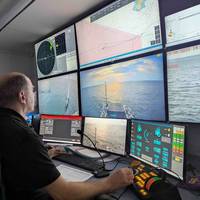
ACUA Ocean has announced the launch of FleetMind, an integrated platform monitoring system for autonomous vessels, filling a gap in the medium and large unmanned surface vehicle (USV) management capability.While existing autonomy software solutions focus on command and control, navigation and collision avoidance, end users are consolidating the number of systems being deployed. This necessitates a modular approach to the C2 software integration layer, allowing focus to be spent on reducing the operating burden of vessel management and maintenance.
Better Data, Modular Solutions Drive Bergan Marine Systems
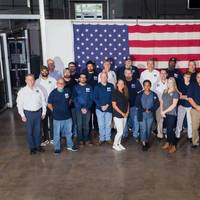
From inland towboats and tank barges, to oceangoing tankers and government fleets, Bergan Marine is literally everywhere you look on the waterfront. Kyle Durden, President & CEO, Bergan Marine Systems, discusses the rich history of this company; born in 1975 in Norway but operating from Florida since 1980, Bergan Marine Systems offers a full family of product and services that are connected, modular solutions that reduce installation and operating costs – ultimately providing better data.When Kyle Durden reflects on his maritime career…
OS Energy to Equip New Vessels with Sonardyne's SPRINT-Nav DP System

Offshore service provider OS Energy has adopted Sonardyne’s SPRINT-Nav DP dynamic positioning (DP) reference system to support its marine renewable energy projects in the North and Baltic Seas. SPRINT-Nav DP will enable OS Energy to maintain DP integrity, even in shallow water and GNSS-compromised environments that are increasingly characteristic of offshore wind construction and maintenance activities. Housed within a single, pre-calibrated unit, the easy to integrate system allows operators ride out GNSS disruption, maintaining safety, accuracy and DP certification.
U.S. Reciprocal Tariffs: The Effect on Inbound Ocean Supply Chains and Compliance

On July 31, 2025, President Trump signed an Executive Order (“E.O.”) modifying reciprocal tariffs that became effective on August 7, 2025. Some aspects of the impact are well understood such as increased tariff burden on importers ranging from 10% to over 40%. Still, other aspects of the practical effect and its knock-on effects for shipping are relatively novel. Understanding these measures is essential for all import supply chain participants and their service providers as real impacts on transportation spend and compliance risk come in focus.The In-Transit ExceptionCentral to the E.O.
Seaspan Returns HMCS Calgary to Royal Canadian Navy After Docking Work Period
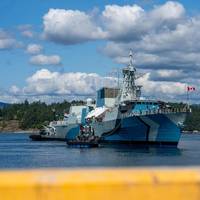
On May 22, 2025, Seaspan Victoria Shipyards delivered HMCS Calgary back to the Royal Canadian Navy, marking the successful completion of the second full Docking Work Period (DWP) under Seaspan’s Halifax-Class Work Period (HCWP) contract.The DWP for HMCS Calgary represents the largest ever completed at Victoria Shipyards and stands as a testament to the coordinated efforts of Seaspan’s workforce and our partners at the Royal Canadian Navy, the Department ofNational Defense, and Public Services and Procurement Canada.HMCS Calgary received a wide range of engineering upgrades…
BAR Technologies Appoints New Technical Director

BAR Technologies, a leader in maritime decarbonization solutions, has appointed Yıldız Saraç Williams as its new Technical Director, effective June 12, 2025. A Chartered Engineer and Naval Architect with extensive consultancy experience, Yıldız joins the company during a period of expansion and global demand for its clean maritime technologies.Yıldız brings more than 25 years of experience from Lloyd’s Register, BMT and Global Maritime, where she led various marine consultancy projects across commercial shipping. She is a Fellow of the Royal Institution of Naval Architect.
DNV, HMD, KSOE Join Forces for Electric Propulsion Digital Test Standards
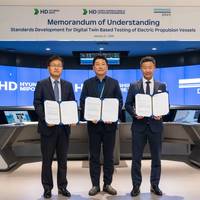
DNV has signed a memorandum of understanding (MoU) with HD Hyundai Mipo (HMD) and HD Korea Shipbuilding & Offshore Engineering (KSOE) to collaborate on developing new standards for using digital twins to test electric propulsion systems.The collaborative project aims to resolve issues related to the integration of highly complex vessel systems for electric propulsion. Utilizing hardware in the loop (HiL) testing via digital twins of the different systems enables integration tests to be performed both earlier in the process on a much broader and deeper level.Together…
How Digital Tech Aims to Make Commercial Vessels Safer, Cleaner, More Efficient
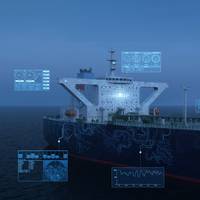
The maritime industry is witnessing a technological revolution that is fundamentally changing how ships operate, improving safe and efficient performance and reducing emissions, all to meet increasingly restrictive environmental standards. Adopting cutting-edge digital technologies enables ship owners and operators to optimize fleets, boost safe and efficient performance and reduce emissions while satisfying ever-developing environmentally beneficial requirements. Digitalization lies here and on the horizon of commercial vessel operations…
Navigating a Safe Future for Us and Our Marine Environment
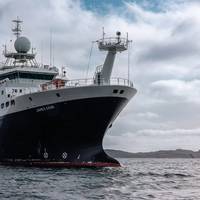
Navigating our oceans safely is always at the center of our maritime operations, whether it’s while deploying instrumented moorings, weighing up to tens of tons and measuring multiple kilometers in length, or working in remote, ice-packed regions.World Maritime Day 2024 (September 26) – 50 years since the SOLAS convention was adopted – is reflecting on how we continue to navigate a safe maritime future. It’s a course we need to chart together, as an industry.As a research organization focused on understanding and protecting our ocean…
Avikus Targets DNV Type Approval for Its Autonomous Vessel Technology
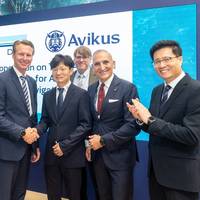
Avikus on Friday announced it is working toward gaining word-first DNV Type Approval for its innovative autonomous vessel systems.The South Korea-based marine technology company said it cemented its partnership with classification society DNV with an agreement signed this week at the SMM maritime trade fair in Hamburg, Germany.Avikus said it is progressing through DNV’s System Qualification process for its autonomous navigation system, HiNAS Control, under DNV-CG-0264 and relevant international standards.
Babcock Takes Charge of Type 23 Frigate Upkeep for Royal Navy

Babcock has been awarded the contract to manage the Type 23 class frigate Refit Support Group, allowing the company to take end-to-end responsibility for vessel upkeep and regeneration in preparation for handover to the ship’s crew.This innovative change follows more than five years of close working between the Royal Navy-led Refit Support Group and Babcock.It frees up UK Royal Navy personnel for front line operations and creates new and exciting roles for 40 Babcock engineering technicians and managers at its Devonport facility…
ABB to Deliver Integrated Propulsion System for CCG’s Next-Gen Polar Icebreaker
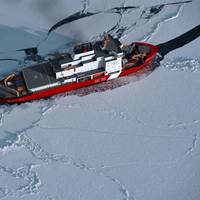
Seaspan Shipyards, Canada’s long-term shipbuilding partner for the Canadian Coast Guard (CCG) and Royal Canadian Navy, has awarded ABB a contract to deliver an integrated propulsion system for the first of the CCG’s new-generation polar class icebreakers.The vessel is expected to be one of the world’s largest and most powerful diesel-electric icebreaker when it enters service in 2030, with ABB supplying vessel systems complying with IACS Polar Class 2 requirements for year-round…
Wrong Size Bearing Led to Engine Failure and Fire on Supply Vessel
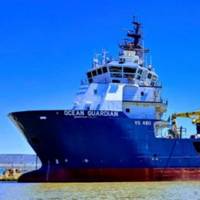
An incorrectly sized bearing led to an engine failure and fire last year onboard the offshore supply vessel Ocean Guardian, reports the National Transportation Safety Board (NTSB).On May 27, 2022, the vessel was conducting a sea trial in Shilshole Bay when its no. 3 diesel generator engine suffered a mechanical failure, resulting in an engine room fire that caused $1.1 million in damages.After maintenance was completed on all four main diesel generator engines in January and February 2022, full-function tests of vessel systems were conducted in open waters.
HydroMAR-E Named Winner of Dft's Clean Maritime Demonstration Competition Round 2
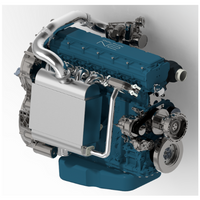
A new pathway toward a low-emission and ultimately a zero-emission future in shipping has recently been opened up through the market introduction of a mono-fuel Hydrogen version of the Recuperated Split Cycle Engine.The HydroMAR-E project is part of the Clean Maritime Demonstration Competition Round 2 (CMDC2) which was launched in May 2022, funded by the Department for Transport and delivered in partnership with Innovate UK. As part of the CMDC2, the Department allocated over…
World’s First Zero-emission Cruise Ship Ordered
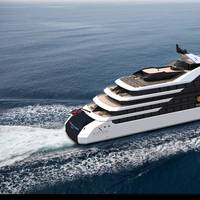
Northern Xplorer has signed a letter of intent (LoI) with Portuguese shipbuilder West Sea for the construction its maiden vessel, said to be the world’s first zero-emission cruise ship.West Sea intends to build the 250-passenger vessel at its facility in Viana do Costello north of Porto for expected delivery at the start of the 2025/2026 cruise season.“As a shipbuilder focused on advanced vessels and high quality, we very much look forward to working together with Northern Xplorer.
DNV Launches Class Notation for Enhanced Tailshaft Condition Monitoring and Performance
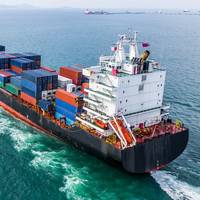
With its TMON(Oil lubricated, +) notation, DNV said it becomes the world’s first classification society to provide a qualified notation that adds another dimension to propeller shaft and bearing condition monitoring.The new notation serves to further minimize propulsion safety risk and prevent costly equipment failure, building on the benefits of the existing TMON class notation. Current DNV class notations TMON(Oil lubricated) and Shaft align are pre-requisites to meet the requirements for assignment of TMON(Oil lubricated…
From Surface to Subsea to Space: U.S. Navy Shipbuilding Outlook 2022
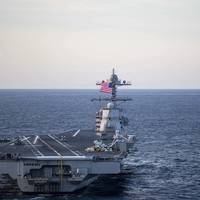
As a rudderless U.S. Navy debates maritime strategy, fleet futures and platform performance, America’s naval shipbuilding industry can look forward to another year of relative stasis.Barring a major geopolitical incident or unexpected maritime provocation, government shipbuilding isn’t going to change course. With Admiral Michael Gilday approaching the final “lame duck” year of his four-year term as Chief of Naval Operations and the 2024 election season looming, the prospect for major changes in the Navy’s demand signal seems limited.Aside from the U.S.



