Orca AI Launches 360° Field of View

Orca AI has launched the next generation of its AI-based operational platform, delivering a 360° field of view (FOV) around a vessel as a foundation for advanced collision avoidance and autonomous navigation.The 360° FOV configuration is enabled by three SeaPod lookout units, each equipped with high-sensitivity RGB and thermal cameras. Working in unison, they deliver continuous full-perimeter coverage and unified situational awareness around the vessel, enabling detection of overtaking vessels and piracy threats…
BMT Opens Digital Simulation Centre in Fareham
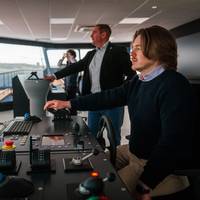
BMT has poened its Digital Innovation & Simulation Centre (DISC) at the organisation’s Fareham site in the UK - a facility designed to provide a premium environment for high‑value simulation, immersive engineering and commercially focused engagement.The facility is powered by the BMT REMBRANDT navigation simulator - a DNV‑accredited system used globally for port feasibility, pilotage training and quantitative navigation studies - alongside new digital visualisation and synthetic environments that support autonomy assurance…
U.S. Coast Guard Releases Report on 2018 Passenger Vessel Collision

On December 12, the U.S. Coast Guard released their report on the collision between small passenger vessel PROWLER and yacht ATTESSA IV, flagged under the Cayman Islands. The collision occurred on October 26, 2018 in the San Diego Bay and resulted in the loss of one life. The report determines that the initiating event of the incident was a collision between the vessels. Subsequent events include loss of propulsion, flooding and passenger injuries/death. Casual factors contributing…
Tocaro Blue Embeds Processing Software into Metal Shark HSMUSVs

Louisiana-based boat builder Metal Shark, a supplier for the US Armed Forces and allies, and Tocaro Blue, a developer of Al-powered marine sensor processing solutions, have announced a strategic collaboration to embed Tocaro Blue's ProteusCore M Radar processing software into Metal Shark's fleet of High Speed Maneuverable Unmanned Surface Vessels (HSMUSVs).ProteusCore provides operators with advanced radar data fusion, machine learning based object detection and classification, and real-time target tracking, improving ISR and operational safety in maritime environments.
Robosys Automation Receives AMC Search Contract Award to Support ASV Training

Robosys Automation, a leader in maritime autonomy and remote operations, has announced a new contract award from the Australian Maritime College, AMC Search, to supply its advanced VOYAGER AI software as a retrofit to its OPT WAMV-16 Unmanned Surface Vessel (USV).This contract builds upon the current successful collaboration between Robosys and AMC Search for where VOYAGER AI is deployed in the Australian Maritime College’s (AMC) Bridge Simulators to build trust in AI navigation testing for STCW watchkeepers as well as to test autonomous COLREGS based Collision Avoidance.
Robosys Automation Secures Offshore Wind Vessel Retrofit Contract
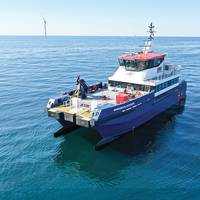
Robosys Automation, a leader in maritime autonomy, vessel control systems, and smart shipping solutions, has announced that it has secured a new contract to retrofit a 26-meter Damen 2610 Fast Crew Supplier (FCS) Twin Axe High Speed Support Vessel (HSSV), with its flagship VOYAGER AI advanced maritime autonomy software.The vessel, built in 2015 to Lloyd’s Register classification standards, is powered by twin Caterpillar C32 engines with direct drives and is equipped with an Alphatron autopilot…
New App Teaches COLREGs

Columbia Group has launched a mobile and web-based app designed to teach the International Regulations for Preventing Collisions at Sea (COLREGs).The COLREGs Challenge is an educational tool which uses gameplay to turn regulatory learning into an immersive, interactive experience.Targeted at cadets, junior officers, and developed in collaboration with 4Growth.com BV, the app presently includes more than 20 interactive modules covering practical maritime scenarios. More modules will be introduced soon.Themed campaigns cover basic navigation…
Metal Shark to Debut High-Speed USV at Sea-Air-Space 2025
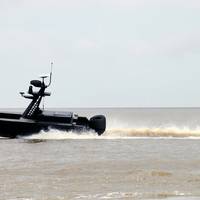
Louisiana-based boat builder Metal Shark is set to debut its latest unmanned surface vessel at the upcoming Sea-Air-Space military symposium in National Harbor, Maryland, with three days of on-water demonstrations.Metal Shark’s new high speed maneuverable unmanned surface vessel (HSMUSV) is a 21-foot military craft specifically configured for unmanned, human-in-the-loop operation. It has been designed to offer the US Armed Forces and allies a low-cost multi-payload USV solution…
SafeNav To Improve Ship Collision-Avoidance
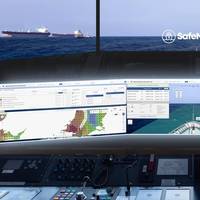
The collision between the MV Stena Immaculate and the feeder containership MV Solong off Grimsby in the UK last week highlights the continuation of maritime accidents, with human error often as the cause. The response to maritime safety concerns is often to invest in better sensors—more advanced Radars, AIS, ECDIS, LIDAR and, more recently, high-resolution computer-vision for enhanced situational awareness. "These tools are absolutely essential, but they only provide fragmented information.
Uncrewed Maritime Vessels Must Leverage AI
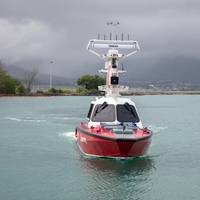
In September 2024, the 33rd Chief of Naval Operations, Admiral Lisa Franchetti, issued her Chief of Naval Operations Navigation Plan for America’s Warfighting Navy. This Navigation Plan embodies “Project 33” in recognition of the fact that Admiral Franchetti is the 33rd Chief of Naval Operations. Project 33 sets targets for enabling the U.S. Navy to make strategically meaningful gains in the fastest possible time. This Plan has several components:The readiness component of the Navigation Plan has the goal of eliminating ship…
Robosys Automation Unveils Autonomous Trial Boat
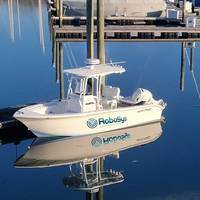
Robosys Automation, maritime autonomy software developer, has unveiled its new autonomous trials boat, which has been commissioned to deliver testing and sea trials in support of integrating clients’ software and hardware with the VOYAGER AI suite.Robosys’ new boat, the “Pioneer,” is a 6.75 meter SeaPro Center Console 222 supplied by Kirby Marine US and is powered by a Suzuki DF 250 APX outboard engine.The SeaPro was selected as a trials boat that features a Dometic Seastar steering system and a Furuno radar.
ClassNK Grants AIP for Maneuvering Assist System
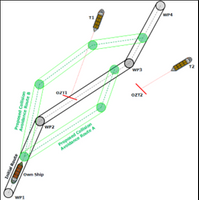
Classification society ClassNK reports it has issued an approval in principle (AIP) for the “Advanced Maneuvering Assistant System”, the core technology for the autonomous navigation system, developed by Kawasaki Kisen Kaisha, Ltd., Kawasaki Kinkai Kisen Kaisha, Ltd., Japan Radio Co., Ltd. and YDK Technologies Co., Ltd.The system automatically generates some routes for avoiding a collision with other ships on a monitored route when a collision with another ship due to OZT is predicted and assists the operator in avoiding the collision.
Recognizing and Meeting the Challenges of Autonomous Vessels
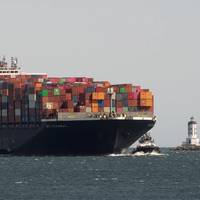
Uncrewed surface vessels (USVs), automated vessels, maritime autonomous surface ships (MASS), remote controlled vessels, and the employment of artificial intelligence and smart marine technology to navigate and operate civilian and military vessels have created a lively debate over utilizing and regulating such technology. Recent articles addressing artificial intelligence (AI) have questioned the value of experience and intuition versus computed logic based upon data and logarithmic differentiations.
Autonomous Cargo Ships and New Collision Regulations
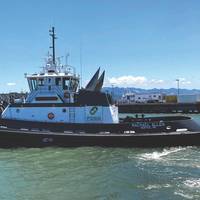
The possibility now exists for ships to navigate the globe with no one at the helm. This capability has been demonstrated in the United States, Europe and Japan by autonomous workboats, survey vessels, and coastwise voyages by autonomous cargo vessels and ferries with the development of larger vessels capable of making trans-oceanic voyages coming soon. Despite this new reality, aside from a patchwork of voluntary best practices, there are no international standards for the safe design…
Philippines Slams Chinese Ship's 'Close Distance Maneuvering'
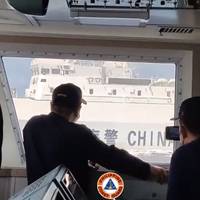
The Philippine Coast Guard (PCG) on Sunday reported a recent incident of "close distance maneuvering" by a Chinese Coast Guard (CCG) vessel in the disputed South China Sea that "constrained" the movement of a Philippine ship sailing nearby.The March 2 incident took place during the PCG's maritime patrol operations around the Scarborough Shoal, locally known as Bajo de Masinloc, the PCG said in a news release.It was yet unclear whether the Philippines had lodged a diplomatic protest for the incident.
Robosys Testing Advanced Navigation Systems on the Solent
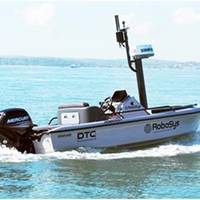
Robosys’ latest product, Voyager 100, is aimed at commercial and workboat vessels and is currently going through a vigorous system-verification series of tests to check and verify that the system is avoiding collisions by making safe and COLREGS compliant decisions – autonomously.For more than a decade, Robosys has been providing Advanced Navigation Systems for manned and unmanned vessels, offering a 24/7 autonomous Situation Awareness capability to keep vessels safe from collision with other vessels or objects.
The Future of MASS is Drawing Closer
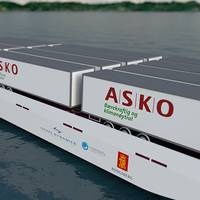
An automated vessel is one where advanced decision support systems onboard the vessel, like the Global Positioning System (GPS) and auto pilot, undertake operational decisions independent of direct human control. A Maritime Autonomous Surface Ship (MASS) involves both automated systems and remote control operations. In August 2016, The Wall Street Journal published an article titled “Ship Operations Explore Autonomous Sailing.” The article suggested that by 2030 there would be remotely controlled ships and that by 2035 there would be MASS on the high seas.In 1974…
'RoboRat' Takes to the Water for 'Intelligent' Autopilot Test
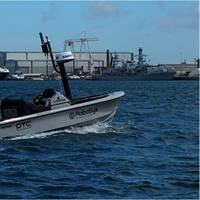
Robosys Automation, developers of Voyager autonomous navigation systems, built in close collaboration with Ring Powercraft, Ambex Marine and DTC, Domo Tactical Communications have put the 'RoboRat' on trial in the Solent area, a trial showcasing Robosys’ latest intelligent autopilot software for commercial and recreational vessels and demonstrations for a multitude of applications are being scheduled throughout the summer. The ‘RoboRat’, designed for inshore reconnaissance/ survey…
Huntington Ingalls Industries Debuts Proteus USV
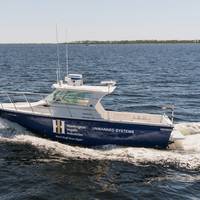
Huntington Ingalls Industries (NYSE: HII) debuted the 27-foot Proteus unmanned surface vessel (USV) for testing and development of autonomy capabilities. Proteus, outfitted with Sea Machines Robotics’ SM300 autonomy system, completed a successful demonstration off the coast of Panama City, Fla., on May 14.“We are thrilled to launch our Proteus USV. The vessel performed exactly as expected with the SM300 system’s proven and safe autonomous capability,” said Duane Fotheringham, president of the Unmanned Systems business group in HII’s Technical Solutions division.
Phoenix Debuts New Navigation Lights
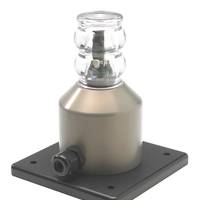
Phoenix Lighting has introduced the SturdiSignal Series of navigation lights- a fully modular and serviceable LED navigation light.Phoenix said its design allows for tool-less repair in minutes, without any electrical work. With a spare LED module kept onboard for field repairs, a vessel can always remain safe and compliant."For years, operators and naval architects have asked Phoenix for navigation light options that are modular and as durable as our other marine LED fixtures…
USMMA: Teaching with Simulation in the Maritime Field
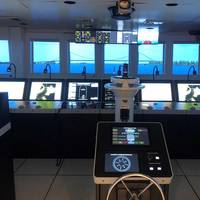
A great deal of research related to student learning styles has emerged in recent years. Through that research strong arguments have been made that more kinesthetic learning methods, such as hands-on or experiential learning, are more effective than more traditional methods like the lecture. In the maritime field, technology such as simulation, has provided us with tools to harness the power of experiential learning; however, those tools alone cannot ensure students are learning…
Maritime Resilience and the Human Element at MRS2020
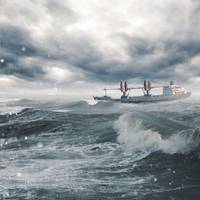
Has the age of maritime discovery and exploration actually ended? Perhaps not exactly. As the history of maritime resilience and the human element shows, as far back as the 1500s and earlier, from using new navigational aids and improved ship designs, to coastal and inland route sailing, to navigating on open seas with uncertain charts, wayward icebergs, dense fog and luckily at times, clear starry nights, mariners have faced human element and maritime resiliency challenges. "Short of food and water…
Autonomy on Trial
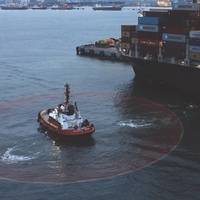
When discussing the arrival of autonomous workboats, many – especially those developing the technologies that enable them – say it’s is not a matter of if, but when. In fact, autonomous harbor tugs are already being put to the test in Singapore, where authorities hope to establish the technological infrastructure to enable fully autonomous ship operations. In the U.S., an autonomous vessel was shown to be able to respond to marine oil spills.But is autonomy really the future?