

Europe Funds Large-Vessel Hydrogen Project

A consortium led by the University of Vaasa has been awarded Horizon Europe funding for the H4PERION – Hydrogen FOR Performance Enhancement and Reliable Ice OperatioN – project which aims to demonstrate how a large vessel can operate with a hydrogen‑capable internal combustion engine.Long‑distance shipping remains one of the hardest sectors to decarbonise. Ships operating for weeks at a time need enormous amounts of energy and absolute reliability – requirements that today’s batteries…
Deltamarin Signs Design Contract for Meriaura Open Deck Carrier

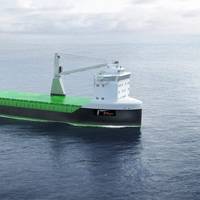
Deltamarin has signed a basic design contract with Jiangsu Zhenjiang shipyard (Group) CO., LTD for Meriaura’s new open deck carrier.Design work will start immediately at Deltamarin Finland, with delivery scheduled for early 2028. The ordered 6,800 DWT open deck carrier is 120 meters long and features 1A ice class and DP2 notation.Deltamarin developed the vessel concept together with Meriaura during 2025, based on Meriaura’s two preceding open deck carriers. The contract signed with the builder…
Batteries: Looking Beyond Spinning Reserve
Mia Elg, R&D Manager at Deltamarin, says there’s not many of the company’s new designs, no matter what the vessel type is, that don’t include batteries.Installing smaller battery capacity to a diesel engine driven vessel with electrical power train can enable spinning reserve. Here, an optimal number of engines can be kept online, and the batteries can work as a black out preventer. This can save, depending on the type of the ship and operation, anything between a few percent…
Deltamarin to Design Six RoPax Vessels for Grimaldi Lines
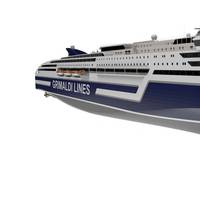
Finnish marine engineering firm Deltamarin has signed a design and engineering contract with China Merchants Jinling Shipyard (Weihai) for six new RoPax vessels ordered by the Grimaldi Group.The agreement includes basic and detail design for the ‘Next Generation Med’ class vessels, which will be deployed across key Mediterranean routes under the Grimaldi Lines and Minoan Lines brands.Of the six vessels, four will sail under the Italian flag and be operated under the Grimaldi Lines brand…
ABS Approves Ammonia Cracking Technology
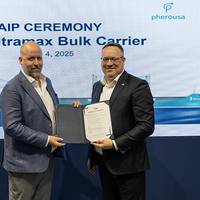
ABS issued approval in principle (AiP) to Pherousa Shipping for its ammonia cracking technology onboard ships, featuring proton exchange membrane fuel cells and fuel gas supply system (FGSS) for fully electric propulsion.The emissions-free propulsion system is targeted for application on Pherousa’s Ultramax 64,000 dwt bulk carrier to transport copper, a key material in solar panels and electric cars, in fully emissions free vessels.“We are seeing rapid innovation and new developments around ammonia as an alternative fuel, whether as a carrier of hydrogen or as a fuel in its own right.
Pherousa Scoops ABS, DNV Approvals for Ammonia-Cracking Tech for Ships

Norwegian maritime technology company Pherousa has secured approvals in principle (AiPs) from American Bureau of Shipping (ABS) and DNV for its ammonia cracking technology onboard ships, featuring PEM Fuel Cells and Fuel Gas Supply System (FGSS) for fully electric propulsion.Pherousa, together with partners, is developing ammonia cracking technology that could make the transition to fossil-free and zero-emission propulsion within the maritime short- to deep-sea transport sectors a reality.Key partners in the work towards the two AiPs include the designers Deltamarin…
Sallaum Lines Orders Six PCTC Vessels
Sallaum Lines has ordered six additional Pure Car and Truck Carrier (PCTC) vessels from China, two with Fujian Mawei Shipbuilding Co Ltd. (2 x 7,500 RT SDARI design) and four with China Merchants Jinling Shipyard (Nanjing) Co. Ltd. (4 x 7,400 RT Deltamarin design). Each vessel has a capacity ranging from 7,400 to 7,500 Car Equivalent Unit (CEU) Pure Car and Truck Carrier (PCTC) design. By incorporating dual-fuel LNG technology, the newbuilds deliver a reduction in carbon dioxide emissions by at least 25%In addition…
Case Study: Onboard CCS Would Result in 10% Fuel Penalty
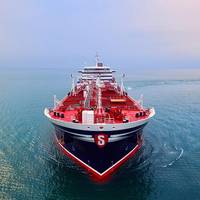
A project assessing the technical feasibility of onboard carbon capture and storage (CCS) has concluded that the technology has the potential to reduce a tanker’s CO2 emissions by as much as 20% per year, with a fuel consumption penalty of just under 10%.The project, Realising Maritime Carbon Capture to Demonstrate the Ability to Lower Emissions (REMARCCABLE), was carried out by the Oil and Gas Climate Initiative (OGCI), the Global Centre for Maritime Decarbonisation (GCMD) and Stena Bulk together with ABS…
World's Largest Car Carrier Höegh Aurora Delivered
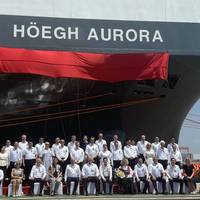
The lead ship of Höegh Autoliners' Aurora class, Höegh Aurora, was delivered at a naming ceremony at China Merchants Heavy Industry’s (CMHI) shipyard in Jiangsu, China, on Tuesday.The newbuild is the first of 12 Aurora Class vessels being built by CMHI. Featuring 14 decks—including five liftable decks—the ship can carry up to 9,100 CEU, making it the world's largest pure car and truck carrier (PCTC) vessel. With enhanced decks and ramps, the vessel is designed to carry electric vehicles on all decks…
World’s Largest Car Carrier Höegh Aurora Set for Maiden Voyage
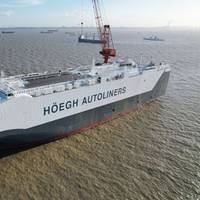
Höegh Autoliners' Höegh Aurora, the world's largest pure car and truck carrier (PCTC) vessel, will soon embark on its maiden voyage and commence commercial operations following delivery at a naming ceremony next week.The newbuild is the first of 12 Aurora Class vessels being built by China Merchants Heavy Industry, in China. Featuring 14 decks—including five liftable decks—the ship can carry up to 9,100 CEU. With enhanced decks and ramps, the vessel is designed to carry electric vehicles on all decks…
Kongsberg Maritime Unveils Fuel Efficient Bulker Design
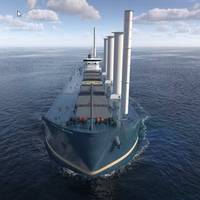
Kongsberg Maritime has unveiled a new 'Super-Efficient Bulker' vessel design concept.Designed with Deltamarin, the vessel promises fuel cost savings between 40-50% depending on the operational profile.Kongsberg Maritime selected a Kamsarmax bulker of 82,000 DWT, a common vessel size globally, as the basis for the new design. The Kamsarmax represents a versatile choice as this vessel type often faces restrictions with the global availability of low-carbon fuels, making it an ideal…
Berg to Supply Propulsion Kit for LDA's Wind-Assisted Airbus RoRos
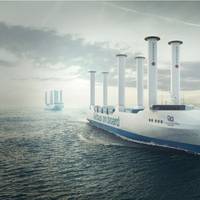
Berg Propulsion has won a contract to deliver the hybrid propulsion solution for three wind-assisted Louis Dreyfus Armateurs (LDA) Ro-Ro vessels.Following delivery by China’s Wuchang Shipbuilding from 2026 onwards, the innovative vessels will carry Airbus A320 Family jetliner subassemblies from France to the final assembly line in the United States.The ships have been designed by Deltamarin with the aim of halving fuel burn and CO2 emissions in transatlantic operations by 2030…
Maersk's Ammonia-fueled Box Ship Design Earns Approval in Principle
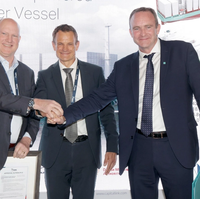
A. P. Møller-Mærsk's newly developed design for an ammonia-fuelled 3,500 TEU container vessel has earned approval in principle (AIP) from classification societies Lloyd’s Register (LR) and the American Bureau of Shipping (ABS).Led by the Mærsk Mc-Kinney Møller Center for Zero Carbon Shipping, the design project also involved MAN Energy Solutions, Deltamarin, Eltronic FuelTech.“To unlock the potential of sustainable ammonia as an alternative, low-emissions marine fuel, we must…
ABS and Lloyd’s Register Greenlight 3500 TEU Ammonia Container Ship Design
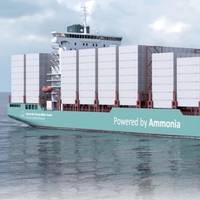
The two classification societies American Bureau Of Shipping (ABS) and Lloyd’s Register (LR) have issued an approval in principle (AiP) for a new ship design of an ammonia-fueled 3500 TEU container vessel.A cross-industry taskforce including A. P. Moller-Maersk, MAN Energy Solutions, Deltamarin, Eltronic FuelTech, ABS and LR led by the Mærsk Mc-Kinney Møller Center for Zero Carbon Shipping is behind the new design.The vessels is 212 meters long, with a breadth of 35 meters. Its ammonia tank capacity is 4300 m3.When awarding an AiP…
New LCO2 Carrier Design Unveiled
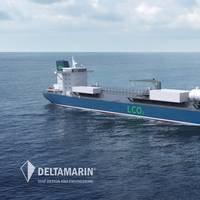
Greece-based mid-stream carbon capture, utilization and sequestration (CCUS) service provider ECOLOG has teamed up with Finnish naval architecture and marine engineering firm Deltamarin to develop a LCO2 carrier designed for tendering at shipyards worldwide.The new design is intra-EU, short range, low pressure and shallow draft.During the initial design, various solutions have been carefully studied in order to optimize the vessel for LCO2 transportation, including different configurations of the cargo containment and handling system…
Lloyd’s Register Issues AiP for Estonian State Fleet’s Hydrogen Fuel-Cell Ferry
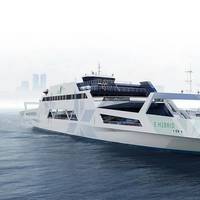
Lloyd’s Register (LR) has awarded Approval in Principle (AiP) to Estonian State Fleet for hydrogen fuel-cell ferry designed by Finnish ship design and engineering company Deltamarin.The zero-emissions ferry is to be operated between the Estonian mainland and the islands of Saaremaa and Hiiumaa, on the Virtsu-Kuivastu and Rohuküla-Heltermaa routes, which connect the Baltic nation to its two largest islands.As part of the certification, LR approved the current stage of the design process to be suitable for further design…
Deltamarin Inks Design Deal for Stena RoRo’s 13th E-Flexer RoPax
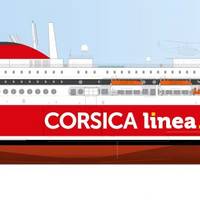
Finland-based naval architecture and marine engineering firm Deltamarin informs it has signed a design contract with China Merchants Jinling Shipyard (Weihai) for the complete basic and detail design of a new RoPax vessel.The new RoPax is the 13th vessel in the Stena RoRo’s E-Flexer series and is the first to be delivered to the Mediterranean region. Corsica Linea will charter the vessel for operation on Marseille – Corsica route from Stena RoRo, with a purchase option. Delivery…
AiP for World’s Largest Car Carrier
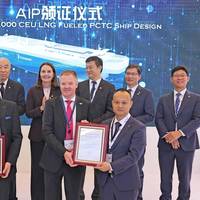
DNV awarded an Approval in Principle (AiP) certificate to China Merchants Jinling Shipyard (Nanjing) Co., Ltd. for its 11,000-CEU capacity pure car and truck carrier (PCTC) design.Recognized as the world's largest PCTC, the 234m long and 40m wide ship will have 14 decks allowing 11,000 car equivalent units (CEUs) to be stored simultaneously, which not only increases efficiency but also reduces the transport cost per vehicle.By implementing a combination of decarbonization measures…
LR Grants AIP for LNG Dual-fuel VLCC Design
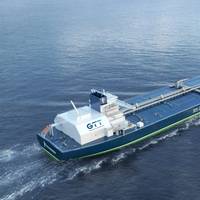
GTT and Deltamarin have obtained an approval in principle (AIP) from Lloyd's Register for their design of a dual-fuel very large crude carrier (VLCC), which incorporates a 12,500m3 liquefied natural gas (LNG) tank equipped with GTT's Mark III Flex membrane technology.The concept developed by GTT aims at maximizing vessel autonomy thanks to a large-capacity tank, giving shipowners and charterers the benefit of longer trade navigation with a single refueling operation, without any…
Neptune Lines Orders Two Car Carriers from China's Fujian Mawei
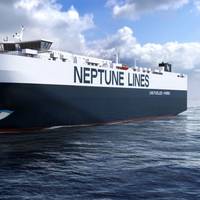
Greek shipping company Neptune Lines announced the order of two next generation car carrier vessels, specially designed for its short sea trades. Fujian Mawei shipyard in China will build the 4,200 CEU DF PCTC vessels for scheduled delivery in 2026.The new vessels, under the Genesis Project, are the first two of a new series which reflects Neptune’s strategy to supplement its fleet over the next decade, increase relevant cargo capacity by 36% from current core fleet vessels, and reduce emissions to remain well ahead of global targets.
OSM Thome and PGS Collaborate on Ammonia-Fuelled Vessels
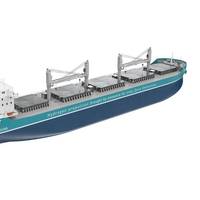
Norwegian companies OSM Thome and Pherousa Green Shipping (PGS) have entered into a Letter of Intent outlining their collaboration on six 63,000dwt Ultramax bulk carriers to be ordered by PGS.The collaboration involves Phases I, II, and III, encompassing Drawing Approval, Project Development, and Site Supervision. Furthermore, OSM Thome will manage the crew and technical management of the constructed vessels.PGS, established in 2023, is in the process of initiating the order for these zero-emission vessels, designed by Deltamarin in Finland.
Höegh Autoliners Opts for Four More Aurora Class Car Carriers
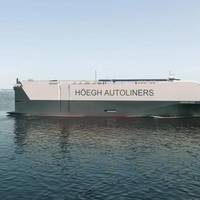
Norwegian shipping company Höegh Autoliners announced on Monday that it has exercised its option to construct four additional multi-fuel and net zero carbon ready Aurora class car carrier vessels at China Merchants Heavy Industry (Jiangsu) Co., Ltd (CMHI) in Haimen.This brings the number of total vessels under the newbuilding program to 12 vessels, all of which will be built by CMHI. Höegh Autoliners has an option to build another four vessels (vessels 13-16), as well as slot reservations for additional four vessels (vessels 17-20).
New Bulk Carriers to Feature Ammonia-to-Hydrogen Cracking
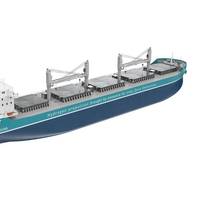
The Norwegian company Pherousa Green Shipping, together with Pherousa Green Technologies, has announced plans for up to six Ultramax dry bulk carriers which will feature ammonia-to-hydrogen cracking technology to provide fuel for onboard fuel cells.Deltamarin has developed the innovative long endurance ammonia-fueled Ultramax bulk carrier concept together with PGT.Metacon recently announced the delivery of its first ammonia cracker prototype based on Helbio's unique tubular reforming reactor technology to Pherousa.



